
Streaming traffic rarely moves in a smooth line. A platform may see a predictable viewing curve on an ordinary evening, then face a wall of concurrent demand when a major match begins or a highly anticipated title drops. The peak-to-average ratio describes the relationship between that routine load and the highest load the delivery system must support.
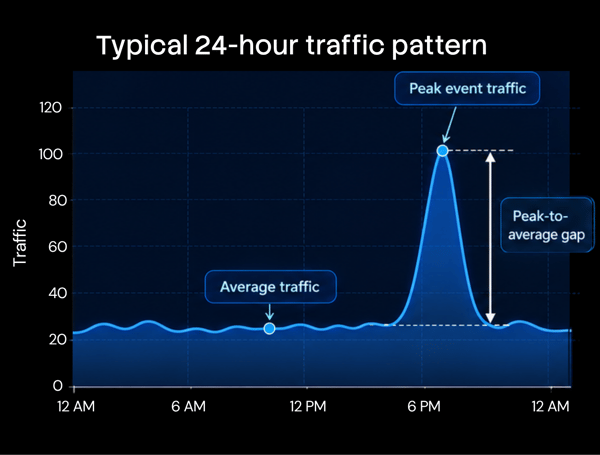
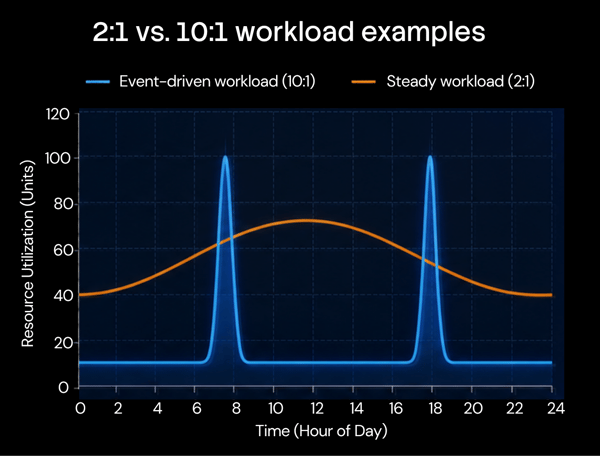
A platform or CDN calculates the ratio from its own traffic data over a defined period. A service that averages 10 terabits per second but reaches 100 during an event has a 10-to-1 peak-to-average ratio. There is no universal “good” or “bad” figure. A high ratio simply means the delivery strategy must bridge a larger gap between routine demand and the peak. The ratio is most useful when the time window and the definitions of “peak” and “average” are clear. Average traffic guides routine planning, while the peak determines whether the most valuable viewing moments succeed.
Why peak demand changes CDN capacity planning
Dedicated infrastructure offers predictability. When a CDN controls a fixed set of servers, ports, and private connections, it knows what is available and can manage those resources consistently. Provisioning that network for a brief, extraordinary peak can also leave a large amount of capacity idle during the rest of the year.
Capacity remains essential, but the number needs context. Buyers should understand how much capacity is active today, how much is reserved for a particular event, how much can be activated through partners, where added capacity will appear, and how long the higher level can be sustained.
For example, imagine a platform that needs an additional 40 terabits per second for a championship game. Two CDNs may report the same active capacity, but one may already be close to its physical limit. The other may be able to activate qualified capacity in the markets where viewers are expected. The headline number is the same; their ability to absorb the event is not.
How Netskrt handles peak-to-average demand
Netskrt uses a software-defined model that can operate across embedded nodes, network-partner infrastructure, and capacity activated for a particular event or season. A control plane coordinates those resources, understands what each location can handle, and directs traffic accordingly.
This flexibility does not create capacity from thin air. Servers, ports, and viable network paths still need to be available. The advantage comes from accessing a broader pool of infrastructure and applying it without rebuilding the delivery platform around every new resource.
This means Netskrt CDN capacity can be added for major events and reduced when the peak passes. That approach helps avoid treating a short-lived spike as a permanent baseline, while still preserving the performance commitments streaming platforms expect.
Look beyond the headline capacity number
CDN marketing often highlights total throughput, number of points of presence, countries served, and peering connections. Each measure says something about the network, but none by itself shows whether a provider can absorb your peak in the geographies where demand will appear. Peak-to-average ratio is a more useful capacity-planning lens because it describes the gap the delivery system must be ready to bridge.
Rather than ask only, “How much total capacity do you have?”, platforms should ask:
- How much usable capacity will be available for this workload?
- In which markets and ISP networks will it be available?
- How quickly can additional capacity be activated?
- How long can the CDN sustain the load?
- What service levels and quality can it prove during the peak?
For live events and other high-demand releases, those answers provide a clearer picture of readiness than one large number on a comparison chart.
Explore more ways to strengthen delivery.

Blog
Peak-to-Average Ratio in CDN Capacity Planning
October 29, 2026

Press Release
Netskrt Expands Oracle Collaboration to Support Streaming Growth with More Predictable Spending
October 27, 2026